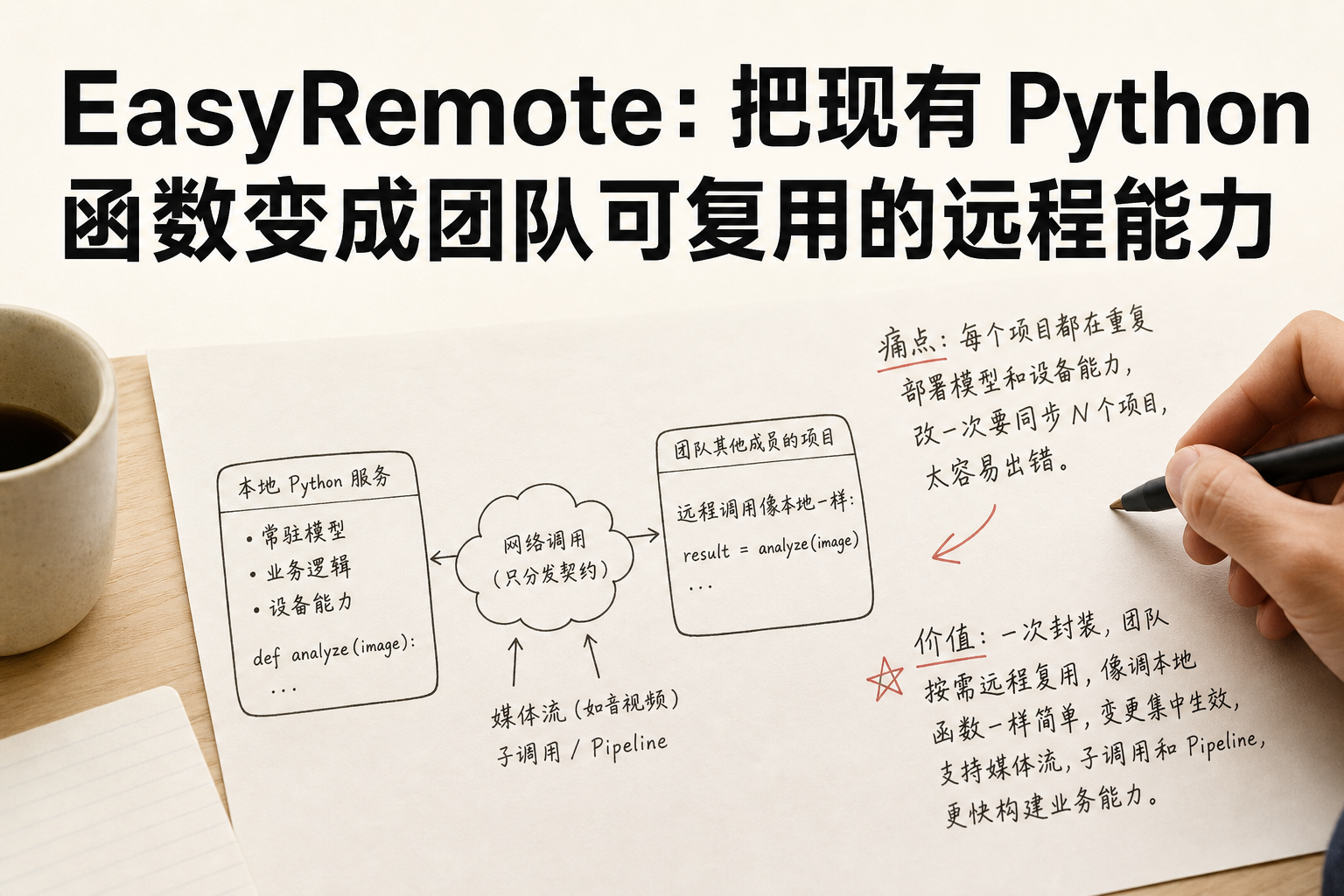

A model runs on lab machines, but colleagues still have to copy weights, check CUDA and dependencies before writing a single evaluation line. Sales needs reusable pricing rules, and rule maintainers have to set up an interface service first. EasyRemote starts from these concrete frictions: publish existing Python functions as EasyNet abilities, so users can submit business parameters directly, and execution continues on machines that own the model, data, or devices.
The provider declares functions with ComputeNode and @node.register, then starts a resident host with node.serve(). Callers write an interface with the same name and signature using @remote, and the function body can be just ellipsis. On call, positional arguments and defaults are bound locally; the real implementation is executed after runtime addressing. Maintainers can thus update pricing algorithms or model implementations in one place; consumers mainly maintain the input/output contract and don’t need to take over the entire execution environment.
This entry point is more than just a simple RPC. A normal function returns a result, while a generator yields text, structured data, or byte frames with media types. When chaining is needed, you can initiate child calls with parent receipts in the host function, or compile multiple steps into a Pipeline for the runtime to execute. Functions thus can be used both for scripting by humans and as a clearly defined step in longer automated workflows.
Nine independent gallery entries in the repository put these options into checkable tasks: use integer amounts for pricing to avoid floating-point ambiguity; resident models accept short text and return an eight-dimensional vector; CRM tools only expose account queries and limited follow-up operations; fault diagnosis outputs are bounded to service evidence; data residency cases only release summaries and labels; cameras and robots display limited image streams and stateful actions respectively. Model vectors currently come from a hash adapter, patient records are synthetic, and devices are simulated. They have already specified parameter constraints, output shapes, and replacement points, so when wired to real resources you can reuse the call interface.
When the same set of functions is used by more teams, the networking library further reduces repetitive stubs: consumers install a manifest to obtain importable .py, type hints, and locked metadata; implementations remain at the provider. The design trade-off here is to distribute the interface first: editors can see the signatures, consumers do not load provider implementations, and the execution environment is connected only at call time.
No comments yet